Hemicrania, Chestnut Review Chapbook Series, 2024
Winner of the 2025 Jean Pedrick Chapbook Prize sponsored by the New England Poetry Club, judged by Matthew E. Henry
Order a signed copy of Hemicrania HERE
Interview about Hemicrania with Maria S. Picone in Chestnut Review
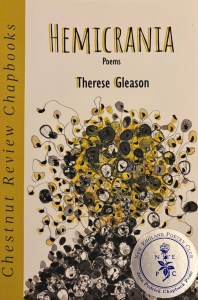
Hemicrania is available from The Poetry Shop, Bookshop, Amazon, Bedlam Book Cafe in Worcester, and Tidepool Bookshop in Worcester
Praise for Hemicrania
In Hemicrania, poet Therese Gleason reaches out through the “half-headed pain” of the migraineur, despite (or rather, because of) “her head a cracked bell/ that wouldn’t stop ringing.” Like the two halves of the brain, this chapbook succeeds by dualities. Both thematically cohesive and formally expansive, Hemicrania tells the story, on one side, of the mostly male failures of medicine, and on the other, of the matrilineal inheritance of suffering “which women must endure.” Borrowing language from medicine but wholly rooted in poetry, the Patient is both reduced to the base elements of piss, salt, bile, and snot and elevated to the mystic, ghostly realm of saints, incantation, and prayer. Gleason asks “what angel, message, lesson” can be found in suffering. But even if, in the end, the Patient resigns, “I’m no more chosen than I am god/forsaken,” the poet has made from her suffering this simultaneously delicate and explosive contribution to the literature of women’s chronic pain.
—Cynthia Marie Hoffman, author of Exploding Head
Chronic and episodic migraine patients will agree that they’ll do anything and everything to exorcise the migraine demon. Author Therese Gleason attempts just that in Hemicrania via revelatory poems brimming with prayers, incantations, and supplications. The poet gives readers the 4-1-1 from the front lines of Migrainesville in poems that confront medical sexism and medical gaslighting— and in poems that explore the conundrum of genetic inheritance. The vulnerability and daily struggle of the person with migraine are depicted with vivid accuracy and candor. Hemicrania should reside on the nightstands of poetry lovers, patients, physicians, and caregivers.
—Rita Maria Martinez, author of The Jane and Bertha in Me
To read Hemicrania is to witness a poet contend with profound spiritual and physical agony. In found poems, hybrid forms, and collages, Gleason traces her family’s matrilineal inheritance of migraine alongside an enraging genealogy of the medical establishment’s all-too-frequent disregard for migraineurs’ suffering. And while Hemicrania is a scorching account of migraine’s brutal toll on body and mind, in its pages Gleason offers too a psalter of companionship: invocations, incantations, and charms against pain drawn from a thousand years of belief and experience. The unflinching intimacy of these poems humbled me.
—Carolyn Oliver, author of Inside the Storm I Want to Touch the Tremble
In Hemicrania, a gut-wrenching and aesthetically innovative portrait of the matrilineal curse of migraine, Therese Gleason renders the ineffable. Equal parts masterclass in vivifying the medical archive and gripping reportage from the patient’s vantage, Gleason’s intimate poems shatter migraineurs’ isolation to deliver spells for a painless future.
—Sarah M. Sala, author of Devil’s Lake
Matrilineal (Finishing Line, 2021), Honorable Mention Jean Pedrick Chapbook Prize, New England Poetry Club
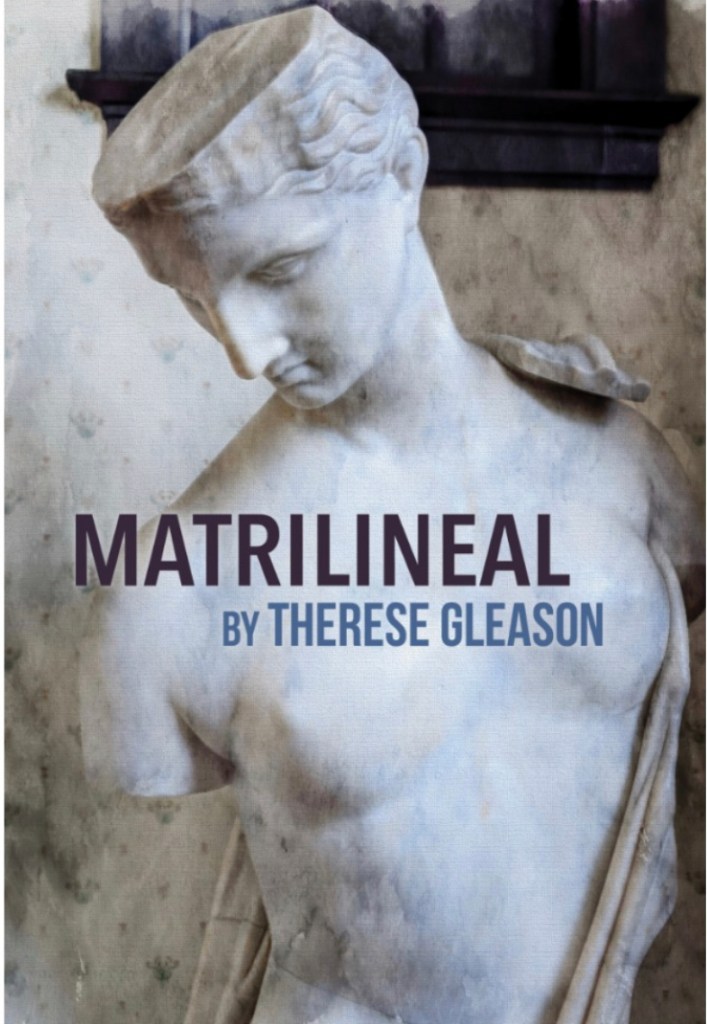
Matrilineal is available from Finishing Line Press, Amazon, Bookshop, and at Bedlam Book Cafe and Tidepool Bookshop in Worcester, MA.
Praise for Matrilineal:
In Matrilineal, Therese Gleason shows the reader the many faces of Mother Eve from childhood to old age, with clarity of vision that omits nothing. The centrality of the female body to the continuity of human life is here, as well as the dual appeal and repulsion of sex; the superstitions surrounding conception and childbirth; the social and religious attitudes that link sex to both duty and sin; the mother-daughter relationship in all its ambiguity; and the equally complex “battle of the sexes” that both divides and links irrevocably those responsible for our survival as a species. The text is studded with surprising poems that include medical procedures, observations on other forms of life, the woman as gateway between the living and the dead, her role as “keeper of the archive” seeking “meaning and patterns,” and an account of a descent into Mammoth Cave “through the black waters they call home.” These haunting poems are guaranteed to keep you wide awake through countless readings.
–Rhina P. Espaillat, Author, most recently, of The Field, and co-author of Brief Accident of Light: Poems of Newburyport, in collaboration with Alfred Nicol.
Therese Gleason’s Matrilineal is poetry of invocation, a calling forth the spirits of family history rooted in the landscape of memory and place. Her poems are archeology that mine the intersections of both the sharp and soft edged fragments of lineage and self that with her craft as poet painstakingly interlock the pieces into a vessel of wholeness. In her collection, Gleason becomes “keeper of the archive” as her “ancestor’s elemental eyes/the color of land, sea and sky, stare through me.” Matrilineal is a poetic journey through the sacred burial ground of both history and the human psyche; hers is language rooted in generations “heady with retrograde legacies” that examines the source of human fractures and attachments. It is a stunning collection that feels important and necessary for our time.
–Maura MacNeil, Author of This Last Place (Dancing Girl Press)
Connected as they are to a rich female life, these poems arrive from various sources. I admire their clean lines and images and the way they interrogate motherhood, ancestry, place and myth. Both brave and redemptive, they do “leave a mark of their own.”
–Joseph Millar, Author of Kingdom
Libation (Stepping Stones Press, 2006), selected by Kwame Dawes as Co-Winner of the South Carolina Poetry Initiative Chapbook Competition
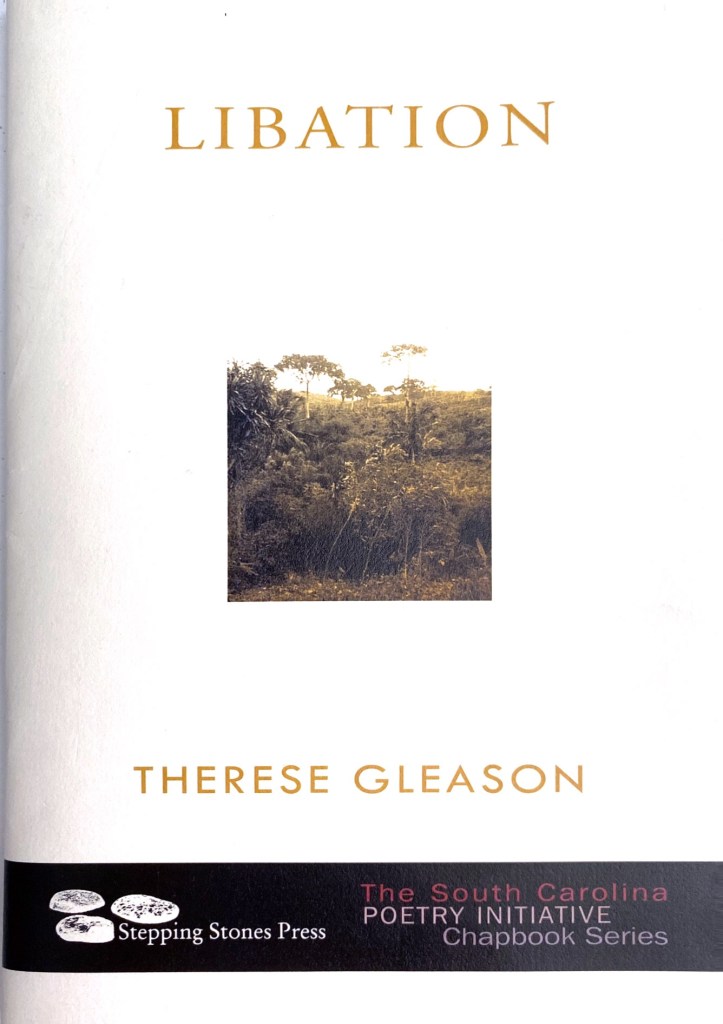
What begins as a trip to Ghana for a white woman becomes a journey that as told by Gleason, eschews cliché and yet flirts with every stereotype of the white woman in a poor African country. Yet she emerges with a work that is aware of all the pitfalls of such a journey and manages to dance through unscathed because of the sharp honesty of her insight and the humanity of her imagination. Beyond that is the sheer strength of language – it’s care for detail and its love of music and pleasure despite the toughness of subject matter. There is a nightmare at the core of these poems, and, indeed, a woman is finding herself, her voice, her own meaning as she discovers a world that is alien to her. It would be easy to simply embrace this work for its dance with the exotic, but Gleason’s poetic instincts are too muscular and sharply self-aware for that. What she creates are poems that make you hold your breath with fear, anxiety and a deep desperate desire for something like redemption. In “White Nightgown” she turns a moment of real illness into the most eloquent and terrible of metaphors:
I hold in my hands a bloody mass.
I coughed it up last night and I don't know
what to do with it.

Part of me wants to bury it like a placenta.
Or maybe I should eat it, put it back inside.
I didn't know I had it in me, such gore.
I heaved it up with one long groan.
–Kwame Dawes, Contest Judge
 Therese Gleason